Most price tools show you a weekly average or an eBay estimate. CardTracker tracks the cards you care about against actual Cardmarket listings, updated every few minutes, so you always know what they truly cost right now.
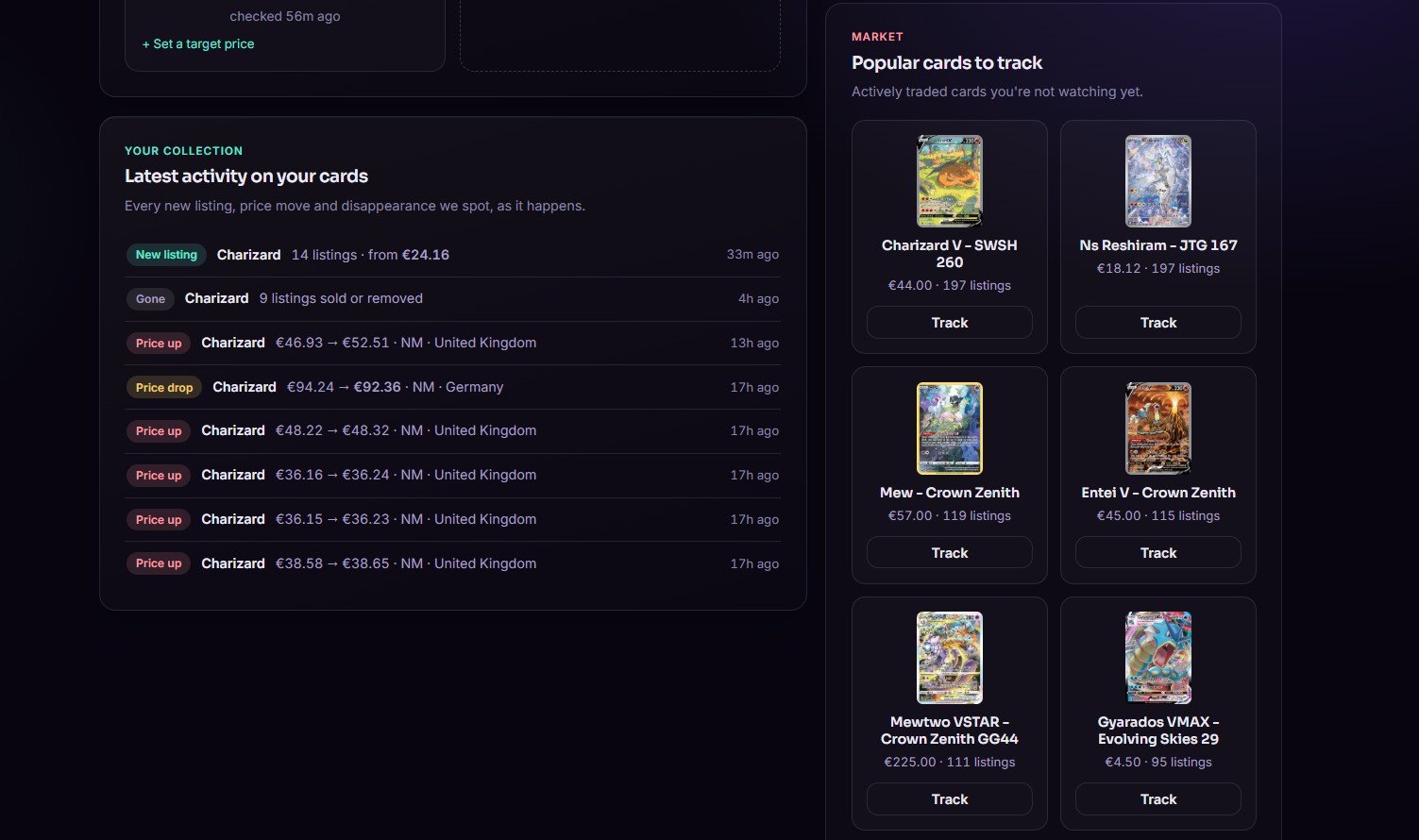
The real, current asking prices on Cardmarket for the exact cards, languages and conditions you track, not a blended average.
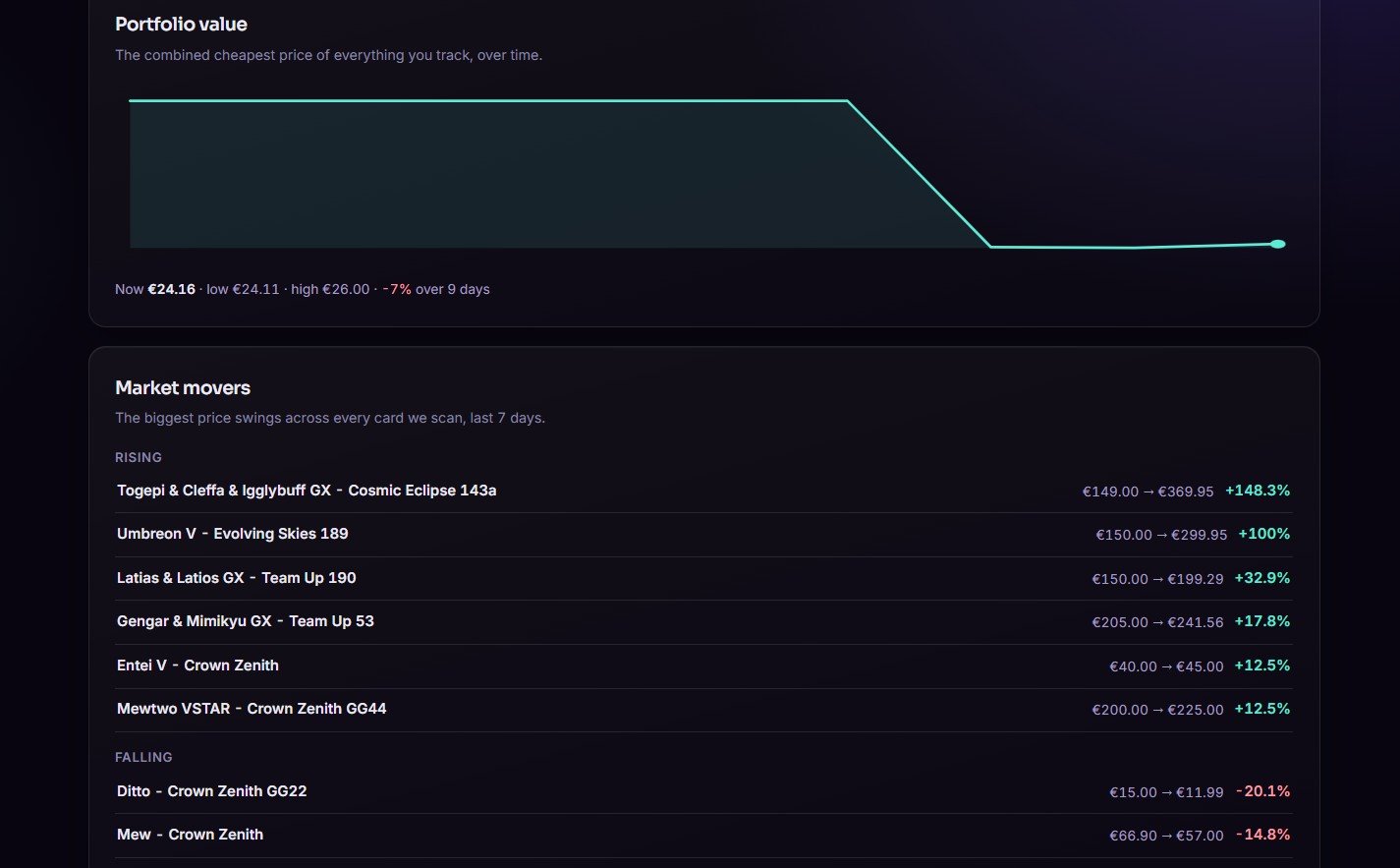
Every scan is stored, so your tracked cards build a real price history over time, the data behind smarter buy and sell decisions.
Track just the cards you care about and check their live market in one place, instead of refreshing dozens of Cardmarket tabs.
Price guides average old sales. Scanners estimate. CardTracker reads the live Cardmarket listings every few minutes, so the number you see is the price a real seller is asking right now, timestamped and verifiable.
how often we re-check your cards' live prices
Cardmarket is a European marketplace, so it moves on European time. From watching the market every day, we see new listings cluster in the German morning, again around lunchtime, and once more in the evening when sellers get home and price up their mail day. Prices follow the same rhythm: a card rarely drifts down slowly, it gets undercut in bursts as sellers react to each other.
The volume surprises most collectors. Across a watchlist of around thirty popular chase cards, we track more than 1,600 new listings in a typical week. That is a fresh copy of a card someone is hunting roughly every six minutes, all day, every day. The cheapest copies of sought-after cards are usually gone within hours, sometimes minutes. If you check prices once a day, you are not seeing the Pokémon card market, you are seeing yesterday's leftovers.
Paste the Cardmarket cards you want to track and set your language and condition.
CardTracker re-scans Cardmarket every few minutes and records every price it sees.
See live prices any time, and get an alert the moment a card is underpriced or newly listed.
A single listing can lie. One seller prices at half value to move stock fast, another fishes at triple. So CardTracker never takes one number at face value. Every scan reads the full set of live listings for your exact filters, language and condition included, then builds the market reference from the cheapest genuine listings rather than any single outlier. Obvious junk prices are filtered out so they cannot poison the average.
Every price is timestamped and saved, which is what turns scans into real price history. And because the source is a live listing, you can always click through and verify the price on Cardmarket yourself.
Most trackers are built around eBay and TCGplayer in the US. CardTracker is built on Cardmarket, the biggest Pokémon marketplace in Europe, so the prices reflect the market you actually buy in.
| Price guides | Refreshing yourself | CardTracker | |
|---|---|---|---|
| Data freshness | Weekly averages | Whenever you check | Every few minutes |
| Price source | Blended estimates | Live listings | Live listings |
| Price history | Sometimes, averaged | None | Every scan saved |
| New listing and deal alerts | None | None | Push and email |
| Your time | Minutes | Hours per week | One-off setup |
A Pokémon card price tracker watches the market for you and records what your cards actually cost over time. Instead of opening Cardmarket, searching a card, filtering for language and condition and jotting the number down somewhere, you add the card once and let the tracker do the checking. CardTracker scans the live listings every few minutes and keeps the history, so "how much is this card worth right now" always has a current answer you can verify against the real market.
Card prices on Cardmarket do not move on a weekly schedule. A tournament result, a reprint announcement or one viral video can reprice a card in hours, and the cheapest copies are always the first to disappear. That is why CardTracker checks every few minutes rather than once a day. The gap between "price guide value" and "cheapest live listing" is exactly where good buys and bad sells happen, and you can only see that gap if your data is live. For every tracked card you see the cheapest copy, the market average and how many copies are listed, and how all three have moved.
Every scan is saved, so each tracked card builds its own price history: cheapest listing, market average and listing count over time. That tells you whether a spike is real demand or one seller testing the water, whether a dip is a trend or a single underpriced copy, and when a card you have been waiting on has stopped falling. It is the difference between guessing what a card is worth and knowing it.
Collectors completing a master set use it to stop overpaying: when you know a card's real floor in euros, you can wait for the right copy instead of panic-buying the first one. Resellers use the same data the other way, spotting listings priced below the live market before anyone else refreshes the page. And plenty of people simply want to watch the value of their binder move with the market, with real numbers from the marketplace they actually buy in rather than converted US sales data.
CardTracker works for singles in any language sold on Cardmarket, from English and German to Japanese, with condition filters you control. Start with one card free, check the plans for more, or read exactly how it works.

CardTracker started as a private tool built by one collector who kept losing chase cards to whoever refreshed Cardmarket last, while completing his own master sets. Nearly six years in digital marketing taught him how to build the tracking; collecting taught him what actually matters: being first to a fresh listing, and knowing a real price from a fake one. CardTracker is independent and not affiliated with Cardmarket, Nintendo or The Pokémon Company. Read the full story.
It is real Cardmarket listing data, scanned every few minutes. Real prices from real listings, not estimates or weekly averages.
Yes, it is free during our beta. You pick the cards you want to track and we watch their live Cardmarket prices for you.
Any Pokémon single on Cardmarket. You choose the language and minimum condition so the prices reflect exactly the cards you care about.
Add the card to your watchlist and CardTracker shows the cheapest live Cardmarket listing, the market average and the price history, in euros, updated every few minutes. It is the fastest honest answer to "what is my card actually worth".
Yes. Every scan is stored, so each tracked card builds a price history over time: cheapest listing, market average and how many copies are on sale.
Yes. You can track any language sold on Cardmarket and set a minimum condition per card, so the prices reflect exactly the version you collect.
Yes. Price-drop and underpriced-deal alerts are built in, and you also get an alert the moment a new copy of a tracked card is listed. See deal alerts for how that works.
CardTracker is built on Cardmarket, the largest Pokémon marketplace in Europe. eBay coverage is next on the roadmap, so you will be able to watch both from one place.
A guide shows an average. CardTracker shows the actual live listings right now, and flags underpriced and newly listed cards the moment they appear.
